










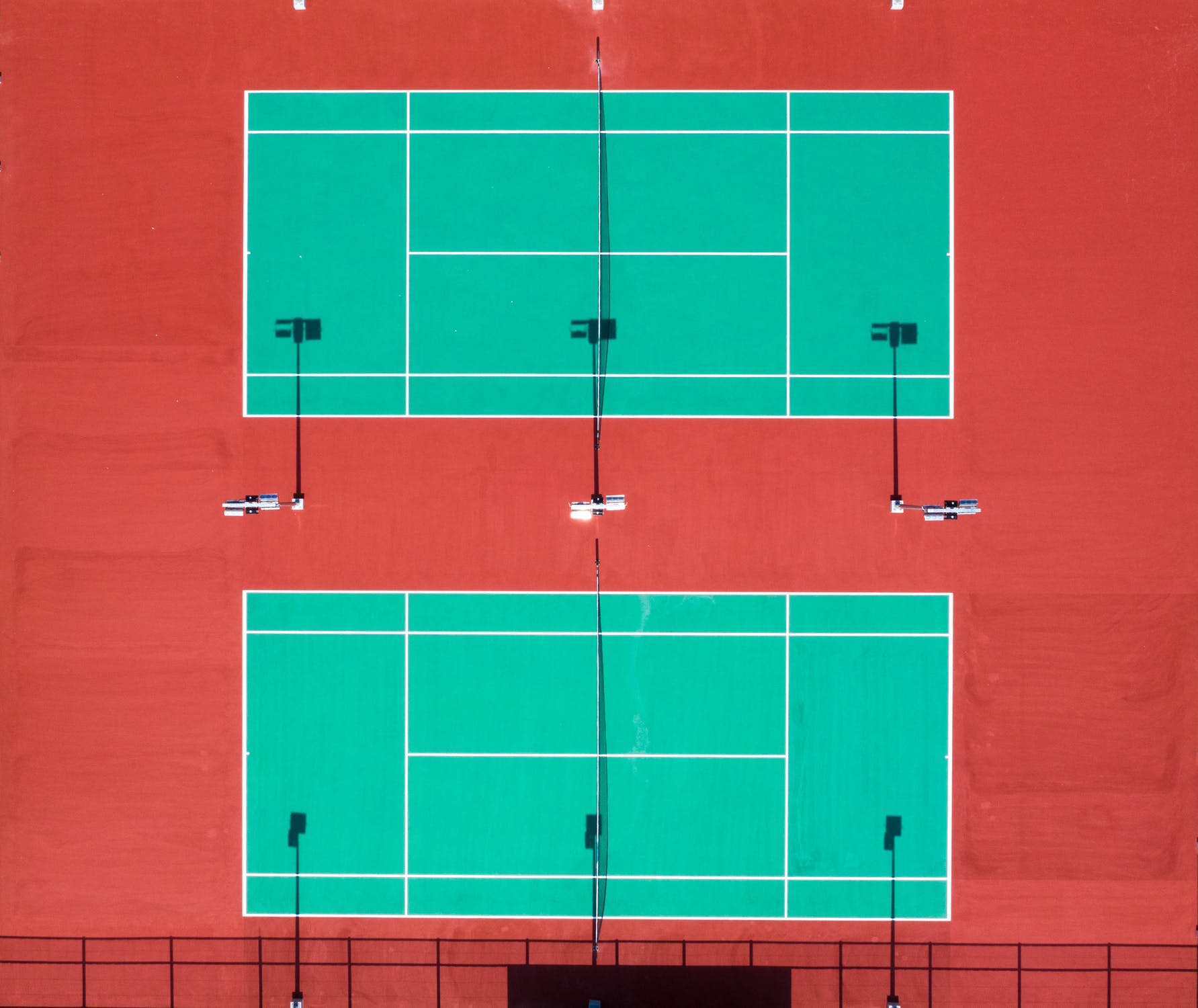
Imagine turning up to a ski slope and finding out that instead of snow, you’ll be sliding your way down a mountain made of mud.
Or running onto your local football pitch, only to discover that the grass has been replaced with sand.
Or jumping into a swimming pool and feeling the cool stickiness of custard wash over your skin…
All of these would likely leave you pining for the return of normality and possibly leave you questioning your own sanity. But don’t panic. We’re fairly sure your local swimming pool won’t be filled with custard on your next visit… Hopefully.
Tennis is one of the only sports in the world that consistently mixes up the surface that it’s played on. The professional ATP and WTA circuits switch between three primary court types.
Hard court. Grass court. Clay court.
All three of these demand their own specialized set of tactical and technical game plans. Preparation and practice are key. If you’re not ready, surfaces will eat your tennis alive and provide your opponents with easy wins.
For each of these surfaces, we’re going to focus on what the ball does when it bounces and how to prepare for it, as well as having a brief look at a couple of key professionals that have excelled on certain courts.
Let’s break ‘em down.
Hard Courts
The most common of the surfaces, hard courts are usually made out of either asphalt or cement held together with a mix of resins to try and alleviate some of the rigidness. The vast majority of professional tournaments are played on hard courts as they are by far the easiest to manage and take care of.
These are knee-breakers if you play on them consistently without proper warm-ups. Hard court tennis demands a lot from your joints!
Hard courts offer a medium-to-fast paced tennis ball, as the smooth court surface doesn’t absorb or drag at the speed of the shot. Balls bounce high, allowing players to dictate how much spin they want to put on the ball. Flat shots are often rewarded on hard courts as well, as power placement will leave your opponent scrambling to get the ball back in play in longer rallies.
Try to hug your baseline if you’re playing hard-court tennis. If you’re pushed out of position, defensive lobs and slices might help to get you back in the point but if this is happening more and more, work on shortening points by making the first attacking move as soon as possible after the serve.
Serve big if you can as well!
Notable hard-court players include Novak Djokovic and Naomi Osaka. Both these athletes rely on their physical prowess to dominate on a surface that rewards consistent rapid-fire attacking play.
With their fabulously tailored groundstrokes and their ability to hug the baseline at all times during rallies, Djokovic and Osaka dismantle their opponents by leaving them with few options. Their opponents will often find themselves trying to mix up play by attacking the net, only to find themselves picked off by well-placed passing shots.
At 23, Osaka has won 4 Grand Slam titles, all of them on hard courts.
At 33, Djokovic has won 18 Grand Slam titles. 12 of them were won on hard courts.
Grass Courts
We’re going classy for the grass!
Taking up only a small percentage of the professional tournament circuit, grass court tennis is generally seen as “old school”. Despite this (or maybe because of it!), winning Wimbledon is still seen by many as the ultimate goal in the sport.
Trimmed and pristine, grass courts need to be well-maintained to allow natural tennis play to occur. Balls will bounce low on the slick slippery surface. You’ll find that you need to bend your knees and keep a stable base as you rotate and swing through your shots. Rallies will often be short on the grass and if you have a natural attacking game, you’ll be rewarded here.
One-two punches and serve-and-volley will get you regular free points. If you find yourself in a defensive position, try and slice to keep the ball low at the laces of your opponent.
When out of position, go for angled shots. With any luck, your rival will be dragged kicking and screaming from their point dominating position and you’ll find yourself able to get back in the point.
Power is good and will be more difficult to handle on a surface that doesn’t offer much bounce. Big serves and attacking approaches to the net are the key to mastering grass court tennis.
Roger Federer and Serena Williams are two gifted grass courters. Their awareness of how to structure and successfully manage points on the surface has led them to Wimbledon trophy after Wimbledon trophy. Both have strong forehands and enough variety within their arsenal to keep defeat at arm’s reach.
At 39, Federer has won 20 Grand Slams. 8 Wimbledon trophies adorn his mantelpiece.
At 39, Williams has 23 singles Grand Slams, with 6 of them being claimed at Wimbledon.
Clay courts
We’re getting dirty and dusty!
Clay court tennis is an entirely different beast altogether and watching players go about their trade on the crushed red brick surface is almost alien if you’ve only seen hard or grass court competitions before.
As we’ve just mentioned, clay courts are not actually made from clay. You’ll find a combination of crushed brick, shale, or stone make up the majority of clay courts around the world, with the slight variations offering more stable or more maneuverable movement.
The important thing to note here is that you’ll need to learn to slide if you’re properly going to master the clay. A firm base and flexible upper body will come in handy as you focus on your swing while letting your feet glide across the court.
You have more time on the clay. Defensive play is the norm, with attacking shots often neutralized with the crumbly courts cushioning speed and absorbing pace. Do NOT wear yourself out early here by going for hard court haymakers early.
Instead, take your time and work the point. Slower balls mean that you have more opportunities to experiment with angles, spin, and shot placement. Longer rallies will reward consistent play and if you’re still in a point that’s gone 20+ shots, you’re doing well.
You’ll want to work on winning most of those extended rallies to have a chance. Mix up your slice and spin. The uneven surface will result in dodgy and unpredictable bounces and it’s important to use that to your advantage.
Rafael Nadal and Chrissie Evert are history-making clay court crafters. Both of these players are willing to grind and grind and grind their opposition down into the depths of defeat. Defensive baseliners who don’t back down in rallies often find their home on the red brick and both Nadal and Evert managed to write their names consistently into the annuls of tennis history with their domination on the surface.
Now 66, Evert retired in 1989, having won 7 French Open titles. She also boasts a record 99.55%(!) win percentage on the clay.
At 34, Nadal currently has 20 Grand Slam titles. We can’t believe we’re writing this but 13 of them are French Opens… Crazy.
To summarise…
The 3 big ones!
Of course, there are other court surface types.
Carpet was steadily phased out of usage in the last few decades and is usually seen as a dying surface.
Astroturf/all-weather courts are often used at local clubs. These pale in comparison to the grass that they’re trying to emulate but at least they require little maintenance!
But generally speaking, hard, clay and grass offer an array of challenges that should keep you busy for a while if you’re eventually hoping to feel comfortable on them all. The variety of court types only adds to the beauty of the battle that tennis lovers adore.
Everyone has a preference.
What’s yours?
This article was written by James from Mind the Racket.









This is woefully incomplete. There is more extreme variation between hard courts than any other surface. Hard courts can range from nearly as fast as grass to even slower than clay. Anyone who has watched matches, or played, at the courts of the citi open and Indian wells can attest to this. Those courts are so dissimilar they need separate categories.